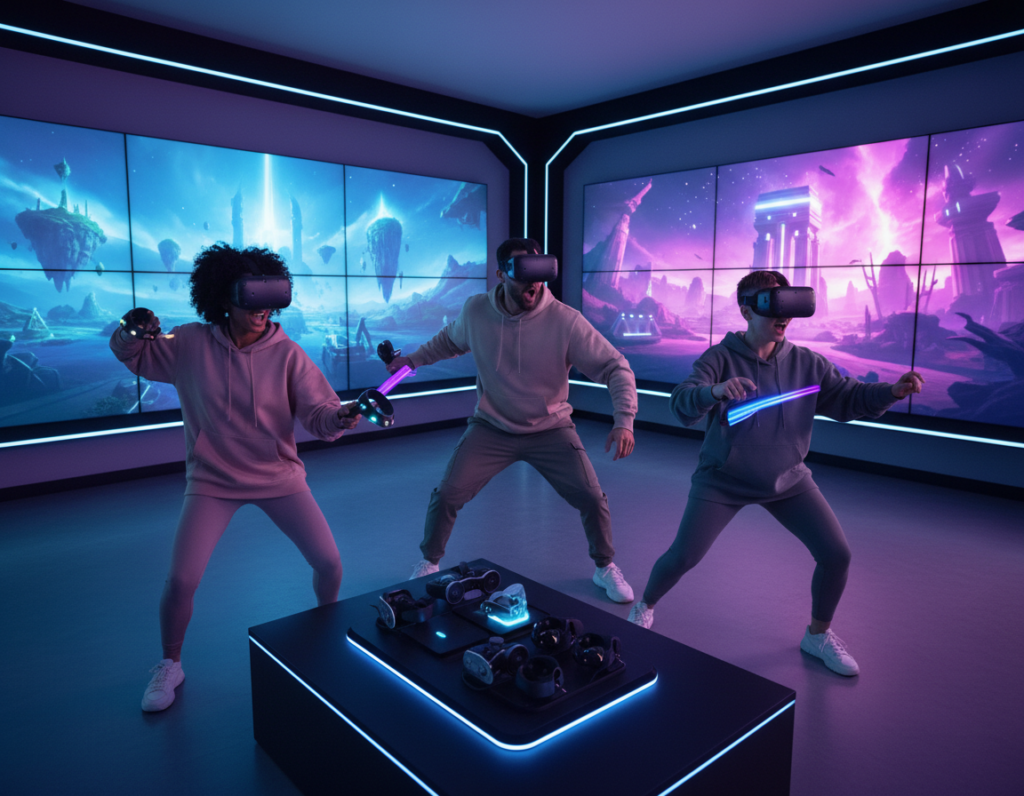
Cloud gaming marks a clear shift in how people reach digital play. It points toward a future where high-end titles stream to any device, removing the old need for costly local hardware.
By moving heavy processing to remote servers, this new way gives users instant access to vast libraries through subscription models. Players can enjoy more games on modest devices with a stable internet link and fewer constraints from console cycles.
The power of centralized computing reshapes infrastructure and levels the field for global audiences. With strong backend networks and data centers, services handle complex tasks so even low-end hardware can render rich video and smooth performance.
Ultimately, this evolution alters the player experience and the platform landscape. It creates fresh access paths, changes the need for local upgrades, and points the industry toward a more open, service-driven future in interactive entertainment.
Understanding Cloud Gaming Technology
Cloud gaming technology runs games on distant data centers rather than on a user’s machine. A single server processes graphics and logic, then streams the visual output back to the device.
That model lets high-quality titles appear on phones, laptops, and TVs with little local hardware. By offloading heavy work, the platform keeps the player experience consistent across platforms.
Modern platforms are built to absorb the intense compute demands that used to sit on a console or PC. With reliable connections and robust cloud computing backends, users can switch devices without losing progress or fidelity.
“Processing happens at scale, so a modest device can play the same game as a high-end rig.”
- Remote rendering reduces local upgrades.
- Centralized storage changes how games are delivered.
- Seamless transitions depend on network reliability.
The Mechanics of Remote Game Streaming
Remote rendering ties player inputs to distant processors that update the game world in real time.
Input Handling and Latency
Input travels as small data packets from a controller to a server. The server processes actions in milliseconds and sends back updated frames.
Any delay in that loop can harm fast-paced play. Robust network infrastructure and high-speed internet keep round-trip times low for a smooth gaming experience.
Video Encoding and Decoding
After the server renders a frame it uses advanced video compression to shrink the output. Efficient encoding reduces bandwidth while preserving visual fidelity on the user’s device.
Developers optimize the streaming pipeline so users feel the same responsiveness as local hardware. Improved codecs and tuned buffers boost performance and reduce visible lag.
“The server processes inputs and returns frames in a tight loop; the network makes or breaks the experience.”
- Low latency input handling
- Efficient video encode/decode
- High-bandwidth, low-jitter network
For a practical comparison of models and services see remote streaming vs cloud gaming.
A Brief History of Gaming on Demand
Early experiments proved the appeal of on-demand play even when infrastructure lagged behind the vision. Developers and platform owners kept testing models to deliver high-quality play to low-end devices.
Early Pioneers and Market Shifts
G-cluster showed a working demo at E3 2000 that hinted at what was possible. A decade later, OnLive launched in June 2010 with a microconsole and a bold push for subscriptions.
Sony’s 2012 acquisition of Gaikai for $340 million signaled industry belief in remote play. Still, limited high-speed networks and publisher skepticism slowed adoption.
“The path included false starts and major pivots.”
- Subscription experiments reshaped how players access video games.
- Many early platforms struggled to stay profitable.
- Consolidation and patent deals narrowed the field.
Despite rocky beginnings, the idea of playing games on demand stayed central to industry strategy and led to today’s more resilient services.
Essential Infrastructure for Seamless Play
Behind every smooth session is a layered infrastructure that moves heavy compute and video quickly to players.
Data centers with high-end GPUs handle the intense rendering load so modest devices can run modern titles. Edge nodes place powerful servers closer to users to cut latency and boost responsiveness.
High-bandwidth internet links and resilient network routes are critical for reliable video delivery. Content delivery networks help scale services to a global audience and reduce jitter during peak demand.
Providers must balance the cost of running large server farms with the need for high availability. Smart resource sharing and optimized server hardware keep operating expenses lower while protecting performance.
“Reliable infrastructure is the only way to ensure on-demand play remains a viable alternative to local hardware.”
- Edge placement reduces round-trip times.
- High-capacity centers handle peak loads.
- CDNs deliver consistent video and data worldwide.
Key Advantages for Modern Players
Modern services let players jump into titles instantly, without downloads or long installs. This shift makes premium play more reachable and easier to manage.
Hardware Independence
Hardware independence removes the need for costly consoles or high-end PCs. Players can enjoy high-fidelity games without buying powerful local machines.
This means more users play games without constant upgrades and pay less for entry.
Instant Access and Updates
Instant access lets someone start a title in seconds. Servers handle patches and updates so the user always plays the latest version.
This model reduces wait time and simplifies maintenance for both players and publishers.
Cross-Platform Flexibility
Cross-platform support enables a consistent experience across phones, tablets, and smart TVs. Players keep progress in the cloud and switch devices seamlessly.
- Play on any device with a screen.
- Move sessions between platforms without losing progress.
- Enjoy a unified player experience across hardware.
Ultimately, these advantages expand the potential audience and make high-end play more convenient for every player.
Overcoming Technical and Industry Hurdles
Latency and infrastructure gaps still define the practical limits of on-demand play for many users.
Low round-trip times are vital to preserve input accuracy and the overall experience. Providers reduce lag by placing data centers closer to players and tuning server workloads.
Adaptive streaming helps when networks fluctuate. It maintains video quality by changing bitrate and frame pacing so play stays smooth on each device.
- Optimize server utilization to lower operating cost and boost performance.
- Use edge centers to shrink physical distance and cut input lag.
- Implement privacy and security controls to protect user data in a shared environment.
Developers also rework games to tolerate variable network conditions and lower hardware demand. Together, better infrastructure, smarter servers, and resilient streaming solutions make cloud gaming services more reliable.
“Solving latency, cost, and privacy is essential for long-term adoption.”
Popular Platforms and Services
Top services connect users’ existing game libraries and deliver instant play across devices. They focus on subscription models and wide access so more players can enjoy high-end titles without buying new hardware.
Nvidia GeForce Now lets players link store accounts to play games they already own. That model reduces friction and keeps personal libraries central to the experience.
Xbox Cloud Gaming is bundled with Game Pass Ultimate and enables users to play games without a console. It emphasizes value through a large catalog and cross-device play.
- PlayStation Plus offers a broad catalog that streams to consoles and Windows PCs.
- Google Stadia demonstrated 4K play through a web browser across many devices.
- Different subscription tiers give users choices by budget and performance needs.
Competition among these cloud gaming platforms pushes better video quality, lower latency, and smarter server allocation. Players benefit from improved streaming and broader access, provided they have a stable internet connection and an active subscription.
“These platforms have transformed how users access and play games.”
The Future of Digital Entertainment
Emerging advances promise to shrink input lag until players feel actions happen instantly. The next era will blend smarter prediction, shared hardware, and wider networks to reshape play.
Predictive Input Algorithms
Predictive input uses AI to guess likely moves and pre-render frames. This cuts perceived latency and makes fast action feel near instantaneous.
Machine learning also adjusts bitrate and frame rate on the fly. That keeps video quality steady when a user’s network changes.
GPU Resource Sharing
Providers now split a single graphics card across many users. New schedulers can push up to 90% of a GPU’s power into active sessions.
That efficiency lowers costs and makes high-end play more accessible. Combined with edge data centers and robust servers, platforms scale without raising prices.
“Unified platforms and smarter resource sharing point the way toward a seamless, device-agnostic gaming experience.”
- Predictive input reduces lag and improves responsiveness.
- Shared GPUs increase scalability and lower costs.
- AI and 5G strengthen infrastructure for higher-quality streaming.
Conclusion
The shift to remote play has reshaped how people access and share interactive entertainment. It makes high-end titles reachable on modest devices and reduces the need for costly hardware. Players gain instant access to a wider catalog through flexible subscription offers and varied services.
Challenges remain: latency, network reach, and infrastructure costs shape what users experience. Providers keep improving servers, data routing, and video streaming so sessions feel smoother and more responsive.
As the industry evolves, this model will broaden access and spark fresh innovation. For a deeper look at trends that will shape the future of play, see the future of gaming.